
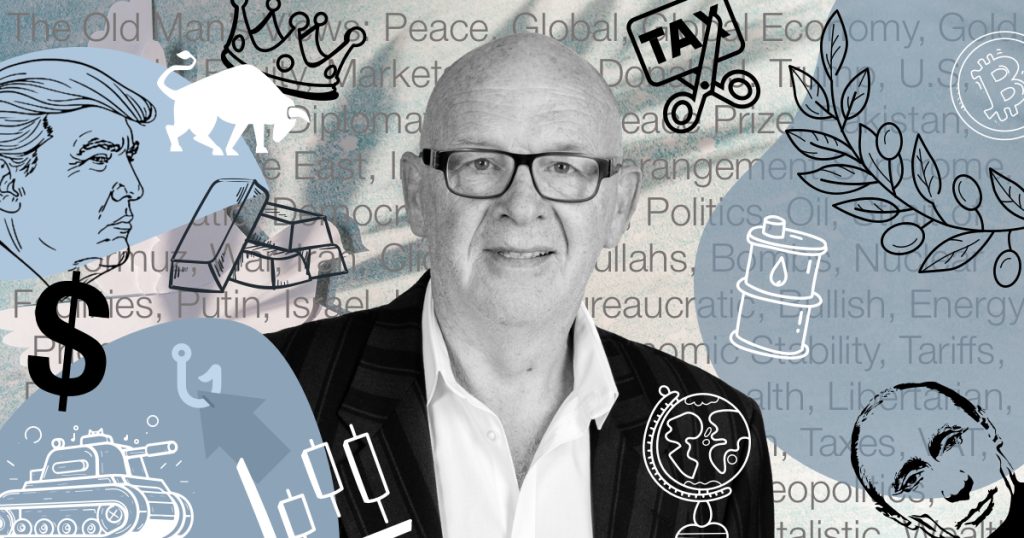
Make no mistake – peace is a result in itself. But what might that mean for the markets and the global economy in general?
Oil below $50? Gold correcting toward $3,000? Bitcoin breaking to new highs?
If this peace is real and durable, these are the kinds of numbers I’d expect markets to start gravitating toward.
Equity markets should rise – possibly sharply – and we may see the dollar stabilize, especially if Trump capitalizes on the moment by attracting more investment into the U.S. from Middle Eastern countries keen to show appreciation for both his show of strength and his diplomatic efforts.
Whether or not Trump gets his Nobel Peace Prize is anyone’s guess. Pakistan has already nominated him – likely in hopes of currying favour – and with Obama having received the prize for far less, it’ll be hard to deny Trump, at least on merit. But let’s see how that plays out.

As speculators, it would be reckless to assume this move toward Middle Eastern stability will come without the odd flare-up. That said, most people – including a surprising number of Iranians – seem to genuinely want peace. This could be the beginning of something extraordinary.
Of course, mainstream media will continue to bash Trump, and those suffering from Trump Derangement Syndrome (TDS) will demand impeachment for the crime of creating peace – without Democratic support and without much Western multilateralism. But that’s the reality of today’s politics.
Just a few days ago, people were talking about oil topping $100 – driven by fears of the Strait of Hormuz being shut down. As it stands, that scenario looks to be off the table for now.
Some claimed an extended war with Iran, and the potential closure of the Strait, would benefit Trump by forcing Europe to import more U.S. oil. But that “theory” was mostly click-bait for the anti-Trump crowd. The notion that Trump would start a war for oil sales is as weak as it is cynical.
Yes, the Iranian regime – sadly, still run by mad mullahs – shouldn’t be trusted or underestimated. But if Trump can bring peace after dropping 14 bombs on nuclear facilities, I’m confident he can also handle a few sea mines in the shipping lanes.
Let’s hope Putin is paying attention to what Trump (and Israel) have achieved in the Middle East. It might just inspire him to enter peace talks over Ukraine. If so, the ripple effects could be global.
Last week, I discussed the risk of everything coming off the rails if our so-called leaders didn’t begin approaching problems with common sense. Many didn’t. But Trump, in my opinion, did – by showing strength when it was needed most.
Which brings us to the bigger point: common-sense solutions beat bureaucratic inertia every time. If more politicians adopted this approach, the outlook would brighten considerably – and that would be a bullish signal for markets. Make no mistake: lower energy prices are the key.
Creating peace, increasing oil output, and cutting the unsustainable subsidies we currently shovel into unreliable renewables (which we can’t afford) is – again, in my humble opinion – the common-sense path to economic stability. Tariffs, when used wisely, can also support domestic manufacturing, boost employment, and drive both national and personal wealth.
Yes, mine is a libertarian viewpoint – one that bureaucrats loathe and much of the younger generation struggles to grasp. But it’s a worldview held by some of the most powerful people on the planet, including the current leader of the Western world: Donald J. Trump.
It’s clear where Trump wants to take the U.S., and that path will benefit working Americans. Sadly, Europe likely won’t follow, and as a minor economic powerhouse, that refusal could come at a cost to European prosperity.
Let’s face it: oil powers the engine of the global economy. The cheaper it is, the more growth it can fuel. Americans, thanks to lower taxes, will see the benefits more directly. In Europe, however, those benefits are usually swallowed up by rising VAT and fuel taxes – making progress slower and less impactful.

In the near term, we may see a bit more upside in European equities and currencies – though frankly, I don’t fully understand what’s driving that momentum. But ultimately, if Trump stays the course, his success in revitalising the U.S. economy will match his success in reshaping geopolitics – and that will be ultimately reflected in the strength of the dollar.
Equity markets won’t move in a straight line – we’ll see corrections, and they’ll be healthy. But I’m far more confident in U.S. equities than I am in European ones. Why? Because Trump believes in fewer rules and less red tape to unleash growth. Europe, by contrast, seems capable only of creating more costly, market-choking bureaucracy.
I know many won’t agree with my views – but think about it. We operate in the most capitalistic business in the world. We risk our wealth to generate more wealth – and we accept personal responsibility for our decisions. I don’t know about you, but I don’t risk my capital so someone in Mozambique can get a taxpayer-funded gender reassignment surgery, paid for by levies on my profits.
Let’s be honest. All of us appreciate the value of a safety net for the disadvantaged, but surely we have had enough of the bureaucratic rule which taxes us too much and returns us too little.
No. Trump is neither tyrant or king. What we are seeing however, from the results of his common-sense, real-world policies, he is doing right for his people, which should prove right for the world, and hopefully, this will benefit those of us who invest and speculate in capital markets!
The post What Price Peace? first appeared on JP Fund Services.
The post What Price Peace? appeared first on JP Fund Services.
The post What Price Peace? first appeared on trademakers.