

The early weeks of 2026 have already delivered a clear message to investors: the global political landscape is becoming more confrontational, less predictable, and increasingly resistant to established power structures.
What we are witnessing is not a series of isolated events, but a broader pattern of push-back – against institutions, governments, and long-standing political assumptions.
For markets, this matters deeply. Periods defined by political fracture and institutional conflict tend to reshape capital flows, elevate volatility, and reward caution as much as conviction.
The White House vs. the Federal Reserve: Institutional Stress at the Core of Markets
In the United States, the growing conflict between President Donald Trump and Federal Reserve Chairman Jerome Powell has moved beyond rhetoric and into institutional confrontation. The administration’s frustration with the pace of interest-rate reductions has been clear for some time, but the decision by the Department of Justice to initiate legal proceedings against the Federal Reserve marked a significant escalation.
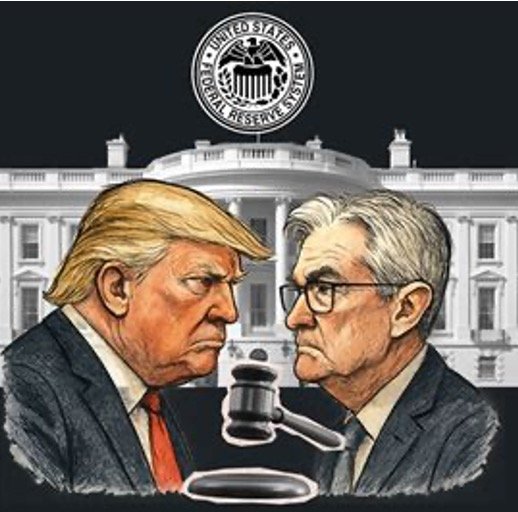
For investors, the substance of this dispute is less important than its implications. The independence of the Federal Reserve is a foundational pillar of market confidence. Any perception that monetary policy is being influenced through political or legal pressure risks undermining trust in U.S. financial governance.
Powell’s public response – firm, direct, and unapologetic – signals that the Fed is prepared to defend its autonomy. While a resolution will eventually emerge, the uncertainty created in the interim is already visible in market behaviour. Demand for perceived stores of value, notably gold and Bitcoin, has increased as investors seek protection against institutional instability and policy unpredictability.
This is not simply a debate about rates; it is a contest over control, credibility, and confidence – all of which sit at the heart of asset pricing.
Europe’s Pushback: Sovereignty, Control, and Policy Reversals
Across Europe, we are seeing governments encounter growing resistance to centralized policy initiatives. The most visible example has been the backlash against the proposed introduction of digital identity systems.
Hungarian Prime Minister Viktor Orbán’s opposition to the EU’s digital ID framework, combined with the UK Labour government’s forced reversal on similar plans, highlights a widening gap between political ambition and public tolerance. While these developments have temporarily slowed implementation, they do not represent a structural shift in European governance. Power within EU institutions has expanded steadily for decades, and policy momentum rarely reverses permanently.
For investors, this underscores a key risk: regulatory and political uncertainty across Europe is likely to persist, creating an environment where sudden policy U-turns, delays, or enforcement changes can materially affect sectors tied to data, finance, and technology.
Greenland, NATO, and Strategic Assets
Denmark’s efforts to rally European partners around retaining control of Greenland – in response to U.S. pressure – may appear symbolic, but the underlying issue is strategic access. Increased Russian and Chinese activity in the Arctic has elevated Greenland’s importance as a geopolitical asset.
While it is unlikely Greenland will become part of the United States, investors should expect intensified negotiations within NATO that lead to greater military investment and infrastructure commitments in the region. This has potential implications for defence spending, resource exploration, and Arctic logistics – sectors that often move quietly before attracting broader attention.
Iran: A Potential Systemic Shock
Perhaps the most consequential development is unfolding in Iran, where widespread resistance against the ruling Islamic leadership is gaining momentum. Should this movement succeed, the emergence of the first “former” Islamic Republic would represent a seismic geopolitical shift.

The risks are obvious: instability in energy markets, regional conflict, humanitarian costs, and heightened volatility across Middle Eastern assets. But for investors, the larger takeaway is that regime change – or even the credible possibility of it – introduces asymmetric risk. Markets tend to under-price these scenarios until events accelerate rapidly.
What This Means for Investors in 2026
- Risk management and capital preservation will be as important as growth.
- Political decisions and institutional conflict may outweigh traditional fundamentals in driving short- to medium-term price action.
- Technical signals, sentiment, and capital flows may offer clearer guidance than macro models built around stable governance and predictable policy.
This is also a U.S. mid-term election year, effectively turning markets into a referendum on President Trump’s “America First” agenda. Policy proposals – such as temporary caps on credit-card interest rates – should be viewed through a political lens. Distinguishing between rhetoric designed to mobilize voters and policies that are economically feasible will be critical.
Conclusion: A Year That Demands Discipline
2026 is shaping up to be a year where investors must remain alert, flexible, and disciplined. Volatility will create opportunity, but it will also punish complacency. In an environment dominated by political instability, institutional stress, and rapid shifts in public sentiment, preserving wealth may prove just as challenging – and just as important – as growing it.
How the cards are played from here will matter greatly. Our task, as investors, is not to predict every outcome, but to stay positioned, informed, and prepared for a world that is changing faster than most models assume.
Please note the political opinions expressed above are those of the author himself, and do not necessarily reflect the opinions of JP Fund Services AS.
The post The Global Fightback: Political Fracture, Power Shifts, and What They Mean for Markets in 2026 first appeared on JP Fund Services.
The post The Global Fightback: Political Fracture, Power Shifts, and What They Mean for Markets in 2026 appeared first on JP Fund Services.
The post The Global Fightback: Political Fracture, Power Shifts, and What They Mean for Markets in 2026 first appeared on trademakers.