
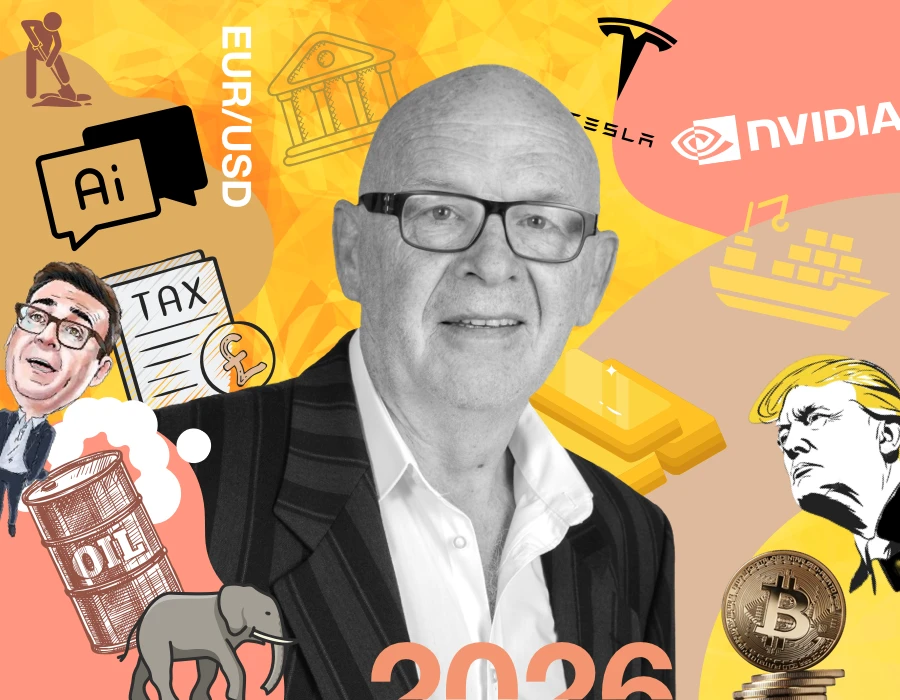
The first six months of 2026 were not exactly dull, were they? We started January with investors still arguing about inflation, interest rates, overvalued tech, oil risk, and whether Bitcoin was a proper asset or just a very expensive mood swing. By the end of June, the same arguments were still going on – only louder, more emotional, and with a few missiles over the Strait of Hormuz thrown in for good measure.
The S&P 500, to its credit, did what good bull markets often do: it climbed the wall of worry. By late June, the index was up around 9% for the year, with the Nasdaq doing even better, helped by the same old engine under the bonnet – artificial intelligence. Markets may have worried about inflation, the Middle East, and the Fed, but money kept finding its way into anything connected to chips, data centres, power demand, and AI infrastructure, which tells you plenty about how resilient investor appetite remained.

That said, this was not a clean, cheerful, broad-based rally. Far from it. The AI trade became more selective. Investors started asking whether the big spenders – the mega-cap technology names pouring billions into AI – would actually earn a decent return on all that capital. Meanwhile, many of the companies selling the picks and shovels did rather better than the people digging the holes. Semiconductor and memory names enjoyed a remarkable first half, with AI infrastructure demand still the dominant equity-market story.
NVIDIA remained at the centre of that conversation. The company is still the heavyweight champion of AI chips, but even NVIDIA found itself caught between two competing narratives. On one side, demand for AI computing remains enormous. On the other, investors have become more sensitive to valuation, competition, and whether the AI gold rush is producing enough real cash flow for the companies buying all this kit. By the end of June, NVIDIA was trading near $195, with a market value around $4.8 trillion, which is an extraordinary number however you dress it up.
Tesla had a more uneven ride. It was still a story stock, still loved by believers, still questioned by sceptics, and still tied to the usual bundle of EV margins, robotaxis, Full Self-Driving, China, regulation, and Elon Musk headlines. By late June, Tesla shares had jumped sharply after a long-awaited update to its self-driving software, though the stock was still down for the year at that point. That sums Tesla up quite neatly: one good announcement can light the fuse, but the bigger questions about execution, margins, and autonomy have not gone away.
Over in currency land, EUR/USD spent the first half caught between two central banks that both had reasons to sound cautious.
The euro was trading around the 1.14 at the end of June. The pair was not collapsing, but nor was it screaming confidence. The ECB raised rates by 25 basis points in June, taking the deposit facility to 2.25%, while the Fed continued to talk tough on inflation. That made EUR/USD less about one clean directional story and more about relative discomfort: Europe has weak growth and sticky policy problems, while the U.S. has stronger activity but still-too-high inflation.
The Fed, frankly, remained the elephant in every dealing room. In June, the FOMC said economic activity was still expanding at a solid pace, job gains were keeping up with the workforce, and inflation remained elevated, partly because of energy-related supply shocks. That is not the sort of backdrop that gives traders a simple “buy everything” signal. The market wanted rate cuts; the Fed wanted proof. And as usual, proof was taking its sweet time.
Oil was where geopolitics became impossible to ignore. The Iran conflict and disruption around the Strait of Hormuz put a heavy risk premium into crude earlier in the half, but by late June prices had fallen back sharply as traders looked toward talks and a gradual reopening of flows. WTI was around $70 a barrel on 30 June, down heavily over the month, while Brent was hovering near the low $70s. That looks calm on the screen, but it is not real calm. It is more like everyone in the room pretending not to smell smoke.
The real issue in oil is not just price; it is confidence in supply chains. Shipping through Hormuz may be recovering, but it remains vulnerable. The market has had to weigh weak demand in parts of Asia and Europe against the possibility that one headline, one strike, or one failed negotiation could put the fear premium straight back into crude. That is why oil has been such a difficult trade: the fundamentals and the politics keep pulling in opposite directions.
Gold had a fascinating first half. It did exactly what you would expect during moments of fear, inflation concern, and geopolitical stress – until it didn’t.
After a strong and volatile start, gold was consolidating around the $4,400 to $4,700 area earlier in June, helped by safe-haven demand and structural buying. But by month-end, it had fallen sharply, with prices near $4,000 and June shaping up as a brutal month. The lesson? Gold is a safe haven, yes, but it is not immune to a hawkish Fed, a stronger dollar, or forced profit-taking after a big run.
Bitcoin, meanwhile, reminded everyone why it is not for widows, orphans, or anyone who likes sleeping. After the optimism of 2025, the first half of 2026 turned sour. By late June, Bitcoin was trading near $59,000, with ETF outflows, Middle East tension, and broader crypto fatigue all weighing on sentiment. The fact that Strategy’s enterprise value reportedly slipped below the value of its Bitcoin holdings only added to the sense that the crypto market had lost some of its swagger.
The FTSE 100 quietly did what the FTSE often does: it got on with things while everyone else watched Wall Street. By late June, the index was around 10,580, still benefiting from its heavy exposure to energy, miners, banks, defensives, and international earners. It was not glamorous, but it was useful. In a world of war risk, commodity swings, and currency uncertainty, the FTSE’s old-fashioned sector mix gave it a certain appeal.
Politics also became impossible to ignore in the first half of 2026. Trump remains the dominant market variable in Washington, and love him or loathe him, investors have to price the man, not the emotion around him. His trade policy, tariff threats, foreign-policy unpredictability, and pressure on the Fed have all added another layer of uncertainty to markets that were already walking a tightrope.
The strange thing is that Wall Street has learned to live with Trump volatility. It may not like every headline, but it understands the basic package: lower regulation, pressure for easier money, tougher trade talk, and a president who sees the stock market as a personal scorecard.
That said, the U.S. midterm elections could change the tone very quickly. Polling in June showed Trump’s approval rating under pressure, with one Emerson survey putting him at 39% approval and 55% disapproval, while Democrats held a 10-point lead on the generic congressional ballot. That does not guarantee an election result, of course, but it tells us the political wind is not blowing entirely in his favour. If Republicans lose control of Congress in November, markets will have to think about gridlock, impeachment noise, fiscal fights, and whether Trump becomes even more aggressive on executive action. In plain English, the midterms could turn Washington from a noisy market risk into a full-blown distraction.

In the UK, Andy Burnham is now looking like the next prime minister, and markets will be watching closely. He may promise fiscal discipline and avoid obvious tax rises, but traders can read a spending list. More public ownership, more housing, more regional investment and more state support all cost money.
So, the question is simple: who pays? If it is borrowing, gilts will notice. If it is wealth, property, pensions, business or capital gains taxes, investors will notice. And if it is dressed up as “fairness,” sterling may notice first. Burnham may not frighten markets on day one, but if he tries to rewire Britain without a credible funding plan, the gilt market could do the frightening for him.
For the second half, the key themes are clear enough. Can the S&P 500 keep climbing if the AI trade narrows? Can NVIDIA and the chip complex justify the capital already priced in? Can Tesla convince investors that autonomy is moving from dream to commercial reality? Can EUR/USD hold the 1.13–1.14 area, or does the dollar regain control if the Fed stays hawkish? Can oil stay calm if Hormuz remains one headline away from trouble? And can gold rebuild momentum if real yields stop rising?
My cautious view is this: the bull case is still alive, but it is not cheap, not broad, and not risk-free. Liquidity, AI, and earnings have carried the first half. The second half will need more than enthusiasm. It will need proof.
And we must add politics to the watchlist. Trump faces a difficult midterm season, and if Washington turns nastier, markets will have to price that. In Britain, Andy Burnham instincts point toward more state intervention, more spending, and eventually – because there is no magic money tree – more tax.
So yes, investors can stay cautiously optimistic. But they should keep one eye on the charts, one eye on the central banks, and one very suspicious eye on the politicians.
Please note the political opinions expressed above are those of the author himself, and do not necessarily reflect the opinions of JP Fund Services AS.
The post The First Half of 2026: AI Kept the Party Going, War Kept the Barman Nervous first appeared on JP Fund Services.
The post The First Half of 2026: AI Kept the Party Going, War Kept the Barman Nervous first appeared on trademakers.