
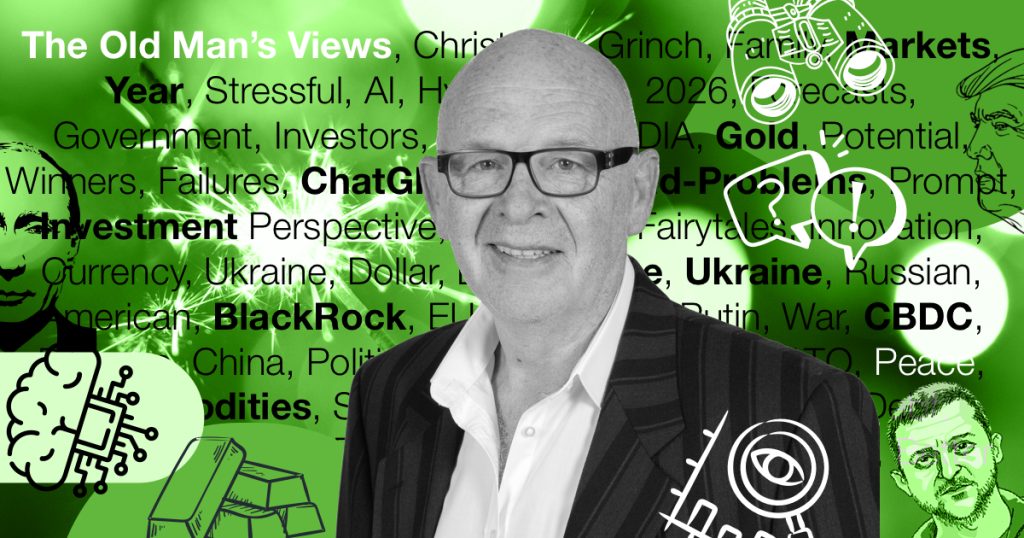
Ho-ho-bloody-ho! That’s another Christmas behind me. I’m no Grinch – I love Christmas with the family – but like markets, it’s exhausting if you’re actually doing your bit. This year I shared it with both my own family and my in-laws, and it went extremely well. Still, anyone claiming Christmas isn’t stressful clearly isn’t pulling their weight.

Santa did his part, handing out a few small rallies to enjoy, which was decent of him. Can it continue? That’s on us now.
AI: Hype vs. Profits
What we need in 2026 is to see AI become profitable, alongside far more realistic earnings forecasts. This feels eerily similar to the dot-com era at the end of the last millennium. If AI appears anywhere in your business model, raising capital hasn’t been an issue. Governments and investors have been throwing money at the sector as if it were a Mexican or Filipino bride.
AI’s growth potential is enormous. But when it comes to glistening like gold, even NVIDIA hasn’t outperformed the yellow metal over the past 12 months. The potential is real; the pricing often isn’t.

There will be clear winners in AI, but there will also be plenty of failures. That means being more discriminating with hard-earned capital in the year ahead. ChatGPT has been a genuine life-changer, but we need AI to move beyond answering questions and into a phase where AI talks to AI – solving real-world problems before we even prompt it.
From an investment perspective, this means selectivity. Short term, hype still dominates. Over the next year, profits need to start catching up with promises.
Forecasts, Not Fairytales
More than anything, investors need realistic profit forecasts, not endless stories of skyrocketing share prices. Innovation is real. Profits, in many cases, still aren’t. That’s how I see it, anyway.
Currency Moves & the Ukraine Reality
Currency-wise, the dollar has weakened against the euro, and many believe the euro’s strength seen since 2022 will continue – especially if peace returns to Ukraine.
While that’s possible, I’m not convinced the EU actually wants peace to arrive quickly. When it does – and hopefully it will – the biggest beneficiaries, aside from the Ukrainian and Russian people, will be American giants like BlackRock, who have already positioned themselves to rebuild Ukraine. What will the EU get for the billions of dollars European taxpayers have poured into keeping this war going? Very little, as far as I can tell.
EU mandarins face a dilemma. Any concessions to Putin will bring pressure at home, yet without concessions, this terrible war continues.
Europe Between a BlackRock and a Hard-up Place
The EU is stuck between a BlackRock and a hard-up place when it comes to Ukraine and the money already spent. Finding a credible excuse won’t be easy. Without one, the already fragile EU project could falter further.
At the same time, the EU and ECB are racing to roll out their CBDC before the war ends and more Europeans wake up and smell the coffee. Once the mandarins get their dirty little hands on everyone’s money and assets, dissent becomes easier to manage. But the fat lady hasn’t sung yet. Hopefully, there’s still time before financial liberty disappears entirely.
For investors, this keeps me cautious on Europe despite apparent currency strength.

Defence, China, and the Next Excuse
If the war in Ukraine ends in 2026, some arms manufacturers may see their share prices take a hit. Few will cry about that – except those politicians collecting back-handers from this industry. Still, not all is lost for the military-industrial complex.
China is ending the year with increased threats toward Taiwan. Any escalation in the South China Sea could limit the downside for defence stocks. Add to that Europe’s promises to bolster military spending now that Trump has threatened to carry less of NATO’s burden.
Peace is good for people. It’s not always great for certain balance sheets.
Why I Like Commodities
As I’ve been saying since summer, I like the commodity sector. Silver, Copper, Aluminium, and Gold, have all finished the year strongly. While some consolidation in non-ferrous metals wouldn’t surprise me, I expect these assets to hold their own over the coming year.
Longer term, real assets still make sense in a world full of debt, promises, and printing presses.
Crypto as Insurance, not a Trade
On digital assets, I don’t know what BTC will do in the short term. I own some, and if it dips further, I’ll add. We all know the limited-supply story, so I won’t bore you.
But with these evil CBDCs creeping ever closer, as a European, I’d be mad not to hold some crypto in a hard wallet – just like the gold I’ve buried out of the way. This isn’t about getting rich. It’s about optionality. We may all need something to trade with if, or when, the shit hits the fan.

Looking Ahead
2025 hasn’t been a great year for me personally, but with a new year approaching, I’m hopeful for better times ahead. Like investing itself, sometimes survival matters more than returns.
This isn’t advice – just how I’m positioning my own capital.
So, with that, I WISH YOU ALL A HAPPY NEW YEAR!
Please note the political opinions expressed above are those of the author himself, and do not necessarily reflect the opinions of JP Fund Services AS.
The post 2026: Hopefully the Year Bullshit Dies! first appeared on JP Fund Services.
The post 2026: Hopefully the Year Bullshit Dies! appeared first on JP Fund Services.
The post 2026: Hopefully the Year Bullshit Dies! first appeared on trademakers.