

What the hell is going on?
For years I’ve been banging on about the direction Europe is travelling, and for years I’ve been told I’m too pessimistic, too cynical, too political and probably too old. Well, the cheque has finally arrived, and Europe doesn’t want to pay it.
More importantly, Europe increasingly cannot pay it. The bond markets are beginning to understand what politicians have spent years pretending isn’t happening. Governments have promised everything to everyone, borrowed like drunken sailors and treated taxpayers as though they are an inexhaustible cash machine. Now the people actually lending them the money are beginning to demand a proper price for the risk.
In Britain, the government continues promising spending it cannot realistically afford, much of it on programmes a sizeable proportion of the population either dislikes, distrusts or never asked for. And gilt investors? They’re sitting there like contestants on an American game show shouting, “The price is right — come on down!” Except the price of long-term money is becoming bloody expensive.
That matters. Forget the daily circus surrounding whether the Federal Reserve moves interest rates by 25 basis points. Markets will continue having their little tantrums every time a central banker clears his throat, but compared with the structural problem developing in Europe, that is small potatoes. The bigger question is whether international investors still want to finance governments whose answer to every economic problem appears to be more taxation, more regulation, more borrowing and more government.
Mainland Europe is hardly in better shape. Capital goes where it is treated best. It always has. Increasingly, capital is looking at Europe and asking a very simple question: why stay? Why keep money in jurisdictions where growth is strangled by regulation, taxation continues climbing and governments increasingly view private wealth as something waiting to be harvested?
Investors are not charities. They will go where they see political stability, economic opportunity and some reasonable prospect that tomorrow’s government will not decide yesterday’s savings have suddenly become socially unacceptable. Money can leave. People can leave. Businesses can leave. Confidence can disappear astonishingly quickly.
Germany has struggled for growth, France continues wrestling with political and social unrest, and governments across Europe are under pressure while populations are being told they must accept lower living standards, higher taxes, expensive energy, greater defence spending and slower growth.
That is quite a sales pitch.
Meanwhile, interest-rate expectations are rising, currencies remain vulnerable and the possibility of recession is creeping back into the conversation. We should certainly welcome lower oil prices and improving traffic through the Strait of Hormuz. Anything that reduces inflationary pressure is helpful. But would I bet the house that the Middle East remains quiet? Not a chance. One missile, one tanker incident, one political miscalculation and suddenly everyone rediscovers why energy security matters.
Then we have technology. Nvidia is valued at around Six trillion dollars. Maybe it deserves every cent. Maybe it deserves more. But sooner or later even the greatest company needs customers living in a functioning global economy. You cannot indefinitely separate equity valuations from economic reality. If global growth slows significantly, corporate spending weakens or the cost of money stays elevated, even magnificent companies can become magnificent investments bought at ridiculous prices.

My own view has not materially changed. I still favour diversification, liquidity and keeping a meaningful amount of dry powder available. Cash may be boring, but boring suddenly becomes beautiful when everyone else is being forced to sell. I also continue to believe Europe faces the possibility of meaningful capital outflows. If that develops, EUR/USD could eventually trade way below 1.07. I am not pretending to know precisely when, but if American politics proves less damaging to the dollar than markets expect, particularly around the mid-term elections, dollar strength could return more aggressively than many Europeans appreciate.
The same argument applies to alternative stores of wealth. If European citizens increasingly believe governments intend to tax, monitor, regulate or restrict their savings, capital will search for escape routes. Bitcoin could benefit enormously from that psychology. A move back above $100,000 would hardly shock me.
Neither would another significant rally in gold. For generations, when citizens stop trusting governments, they buy things governments cannot easily print. Gold has survived empires, wars, revolutions, currencies and thousands of politicians promising that this time everything is under control. That is quite a track record.
I am not telling people to empty their bank accounts, stuff gold coins into their socks and disappear into the mountains. I am saying something much simpler: continue trading, continue speculating and continue taking the opportunities markets give you, but do not become so obsessed with tomorrow morning’s payroll number or the next Fed statement that you completely miss what is happening structurally.
The big picture matters, and Europeans should seriously consider geographic diversification of wealth. That may mean dollar accounts, investments outside Europe, internationally diversified funds or, for sophisticated investors taking appropriate legal and tax advice, properly regulated offshore financial centres. There is nothing inherently sinister about diversifying where assets are held. Corporations do it. Governments do it. Central banks do it. Rich families certainly do it. Yet whenever ordinary people consider doing the same thing, politicians suddenly develop moral objections. Funny, that.
What I would strongly argue against is complacency. Financial freedoms rarely disappear overnight. They disappear gradually: one regulation, one reporting requirement, one tax change, one transfer restriction and one justification at a time. By the time everybody realises the door is closing, getting through it becomes considerably more difficult.
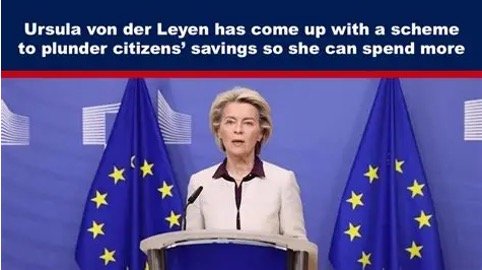
I have very little confidence in Ursula von der Leyen, Christine Lagarde or the broader European political establishment to recognise that increasing centralisation and control eventually creates exactly the opposite of what they claim to want. You cannot regulate a continent into prosperity. You cannot tax it into competitiveness. And you cannot frighten capital into staying.
Eventually, investors vote — not at the ballot box, but with their money.
And that, perhaps, is the most important market signal of all. Watch the bond market. Watch capital flows. Watch where businesses are investing and where wealthy individuals are choosing to live. Politicians can manufacture statistics, redefine recessions and produce
PowerPoint presentations explaining why everything will be wonderful in 2035. Money is considerably less sentimental.
Markets do not care about manifestos. They care about returns, risk and whether they are likely to get their money back.
That does not mean Europe collapses next Tuesday morning. Far from it. Europe remains wealthy, productive and packed with outstanding companies and talented people. But that is exactly why the present direction is so frustrating. The problem is not a shortage of ability. It is an increasingly hostile environment for the very people expected to generate the growth required to pay the bills.
So I will continue doing what I have always done: trade what is in front of me, protect what I have accumulated and keep one eye firmly on the exit signs.
Because when governments run out of money, they rarely conclude that government has become too expensive.
Please note the political opinions expressed above are those of the author himself, and do not necessarily reflect the opinions of JP Fund Services AS.
The post The Cheque Is On It’s Way – And Europe Doesn’t Have The Dough To Pay! first appeared on JP Fund Services.
The post The Cheque Is On It’s Way – And Europe Doesn’t Have The Dough To Pay! first appeared on trademakers.